While fashion of the fifties depicted sweeping elegant gowns and couture dresses worn by mature wealthy elitist women, the sixties style was a total deviation from the past.
Fashion was aimed at youthful trendy women with tastes and preferences for simple geometric shapes, shorter lengths, and looser fits, clothing typical of the British pop scene.
Seamstresses and tailors were beginning to lose business to the mass production of apparel manufacturers. It was a new era of fashion-on-the-go and as style began to change, using elegance as a symbol of prestige and elitism was no longer ‘fashionable’.
As life became more casual than it was in the 50’s there was a change which was also reflected in the fashion industry. There was less of the formal elegant styles of the previous decade and more of semi-formal and casuals, many of which was “mixed and matched to stylishly create different looks for different occasions”
Things were still looking bright economic wise though, and the good times that emerged in the 1950’s continued well into the 1960’s. Austerity and rationing became something of the ‘distant’ past, and many people including women became beneficiaries of the pleasant economic boom.
Commercialisation of Fashion
Suddenly, fashion was becoming commercialised. It became embraced not only by the middle class women, but by the lower class to a certain extent, especially in the Europe and the United States.
And because culture became more relaxed, the 60’s style began to feature more of the following:
Shift dresses
A-line dresses
Pill box hats
Bell bottoms
Mini-skirts and dresses
Bikinis
Trousers suits
If fashion and style of the fifties inspired individual style signatures, it blew up into enormous proportions in the sixties.
Replicating Vintage Style
Experience has taught many of us born in the forties (baby boomers) that fashion and style is cyclic. It has always been a situation where “the old becomes the new”, always, albeit with a twist.
So, to be a part of the vintage inspired fashion crowd, it’s good to know how to put together an ensemble that interprets your favourite era, replicating it in the most pleasing and fashion-forward way. This is quite easy with styles of the 60’s.
Five 60’s Look You Can Replicate
It’s fifty plus years after, but you can still reproduce the following looks today, have your own signature, and whip up a buzz in the fashion scene.
You probably remember them; the great fashion designers of the 1960s.
If you are a baby boomer, those were your teenage years and many of you certainly have a tinge of nostalgia for the swinging sixties . . . the era of kohl-rimmed eyes and false lengthy lashes; micro-mini dresses, space-age suits, and shiny patent boots; fashionable stuff that defined the face and style of the times.
They were great fashion designers of their time and so influential in the fashion scene that they easily 'called the shots' in style.
The fashion of the 1960s centred more on London and not Paris, as some might believe. It was a new look, a total deviation from the fifties style of dressing. It was further divided into several sub-cultural trends, prominent among whichever the other styles can be are these three:
Mods – modern chic look in dramatic urban styles
Hippie – a generally unisex look, flowing clothing, tie & dye fabrics, lots of flowery prints
Biba looks – floppy hats, clothing with Gothic tones, a lean towards 20’s style; very dark eye, nail, and lip make-up.
Key fashionistas of the sixties include:
Twiggy
Mary Quant
Jackie Kennedy
Brigitte Bardot
Nancy Sinatra
Edie Sedgewick
Jean Shrimpton
Famous and Sought-After Fashion Designers
1. Biba Founded by Barbara Hulanicki in the 1960s, Biba lines (which eventually included makeup) were aimed at teenagers mostly and consisted of what we may refer to as today’s high-street fashion. Her colour palette was "muddied colours of brown, sepia, grey and plum" . . . dark but rich.
Biba's "swinging London look" was affordable couture recreation and included the following styles:
Mini-skirts
Long tight sleeves
Maxi skirts
Catsuits
Gingham print dresses
Triangular headscarves
Swanky wellies
Today, if you find an authentic Biba dress, it may sell for as much as $1000
Brighton Museum and Art Gallery celebrates BIBA
2. Givenchy Though he rose to fame in the 50s, Givenchy’s fashion creations and elegant styles still reverberate in today’s scene.
This fashion designer's creations were so refined; it helped to define the 1960s refined style of the chic and sophisticated dressing of movie stars. We all remember the elegant Audrey Hepburn. She was mostly dressed in Givenchy's clothing, whether on or off-screen.
Givenchy's most famed designs includeAudrey Hepburn’s style, The Little Black Dress, which she wore in the movie "Breakfast at Tiffany’s".
3. André Courrèges Courrèges was a French fashion designer who made his 'debut' in the Parisian fashion world of the 1960s with his futuristic, youthful but "high fashion label".
His fashion creations include:
A triangle-shaped shift dress that was THE defining silhouette of the 1960s
Well-cut pants
Halter tops
Short skirts
Hip-hugger pants
Sequined jumpsuits
White mid-calf boots
Vinyl-trimmed coats and suits
Cigarette pantsuit
It is claimed that he is the designer who created the miniskirt. Authentic Courrèges pricey high fashion creations are difficult to find today, but cheaper copies of his works may be found if you can ‘wade’ through vintage clothing hunts.
4. Pierre Cardin The originator of the fifties bubble dresses, Pierre Cardin, is a very famous 60s fashion designer who created innovative, contemporary designs that bordered on the unusual and futuristic.
It was he who embraced the use of hammered metal jewellery, industrial zippers, and plastics in his creations. His famous styles include:
Thigh-high boots
Collarless jackets
Bright-coloured mini-shift dresses
The unisex cosmos suit
Skinny double-breasted suits
Slim trousers
Space-age designs
5. Yves Saint Laurent
Yves Saint Laurent, an influential fashion designer from Algeria, has had a great impact on the European fashion industry right from the early 60s till date, and it’s not uncommon to find that celebrities and models still gush over his designs even though he passed on from brain cancer in 2008.
YSL contributed to many of the sixties fashion trends. Some of his most popular clothing styles include:
Mondrian shift dress
Peacoat
Safari jacket
Women tuxedos
Blazers
Sheer blouses
Jumpsuit
Women smoking jackets
Photographic Original Press – Yves Saint Laurent 1960s
6. Emilio Pucci
This list will be incomplete without the mention of Pucci, "The Prince of Print", whose designs were mostly recognised for his trademark “psychedelic look” - electric colours, bold geometric prints, and 'clean', racy cuts.
Pucci contributed to the '60s trends like no other. Fashionable women and important personalities, Jackie Kennedy and Sophia Loren, wore his styles, and a great fan of his clothing line, Marilyn Monroe, was even buried in one of his clothes.
His popular designs include:
Palazzo pantsuits
Silk headscarves
Body-hugging mini-skirts
Silk jersey clothing
Psychedelic 'op-art' tights – a form of printed leggings
Cropped Capri Pants
Poplin shirts
Space-age-inspired air hostess uniforms
7. Mary Quant
No, Mary Quant didn’t invent the "mini" as many vintage fashion enthusiasts tend to believe. Rather, she gave the style its name by popularising it in the 60s!
Many of us have the Quant look embedded in our minds. The silhouette ensconced in a mini skirt or a mini shift dress, patent boots, coloured opaque tights, a bob-style haircut, prominent and dark eye makeup and false lashes.
To replicate the Mary Quant look today is a breeze, and you'll find a good number of fashionistas adopting the 1960s "quintessential" Mary Quant style. Her designs were pricey, and many women found them unaffordable. Nonetheless, she was regarded as one of "London’s swinging" groups.
Her designs include the following:
Star style
Colourful raincoats
Boots with detachable tops
Mix and match separates
Tight mini-skirts
Hot pants
Lounging pyjamas
Dresses/Skirts with matching colourful tights
1967 Mary Quant fashion show
Finding an original Mary Quant outfit outside of the UK would be like searching for a needle in a haystack, but replication can be achieved by looking out for the right pieces to create the perfect ensemble.
21st Century Interpretations of 60s Fashion Designs
Today, finding these famous fashion designers' originals is certainly difficult, judging by the fact that they 'styled' and set the trends for many of us fashion-conscious youths over half a century ago.
However, it is so good to know that interpretations of their designs are easy to spot in most boutiques, malls, and high street shops. That is, if you know what to look out for.
Unleash the designer in you with this premium fashion sketchbook mood board journal, crafted specially for fashion designers, illustrators, and design students. It is perfect for creating detailed fashion sketches, croquis, and stylish concepts.
Whether you are drafting seasonal fashion collections, experimenting with silhouettes, or refining your signature style, this elegant sketchbook provides a professional canvas for your ideas.
Ideal for portfolio development, fashion school, or on-the-go creatives, for inspiration.
Have you ever wondered when, how, and why people started wearing underclothing? Are you curious about what underwear was like and how it has evolved over the centuries? If your answer is yes and yes, this article will enlighten you.
The history of underwear is quite interesting. It all began from wearing nothing underneath clothing to putting on beautiful frilly lingerie and now barely-there strips of under(things). Indeed, underwear has come a long way.
The Earliest Women Undergarments
The earliest recorded pieces were simple nightie-like garments called shifts, not unlike what we call a chemise. Shifts were worn by women of the Middle Ages, a period of European history spanning from around 500 AD to the 1400s. This chemise was worn underneath the outer garments, and that was it. Women of that era did not wear anything else below their daily attire.
In ancient Rome and Egypt, women tied loincloths which served as underwear. To hold the bosom firmly in place, they wound wide bands of linen fabric around their chests. This equivalent of the modern brassiere is called a strophium, tied with half-knots with the ends tucked in on the sides.
When Underwear Became Intimate Clothing
Around the 1500s to the 1600s, many women wore an item of underwear called a farthingale. It was a bell-shaped hooped petticoat with circular pads of fabric worn under the skirt to extend and shape. It was popular among well-to-do women and played a crucial role in creating the fashionable silhouette of the 1530s to 1580s.
The farthingale frame was constructed essentially from whalebone. The cheaper version was called a bum roll and was a padded roll of textile worn around the waist. By the 1600s, wealthy women began to wear silk stockings.
It was not until the early 18th-century that underwear became a recognized and necessary item of female clothing. By this time, the shift had transited into a more feminine chemise. And by the turn of the 1800s, women began to wear drawers. These are generally known as female pantaloons.
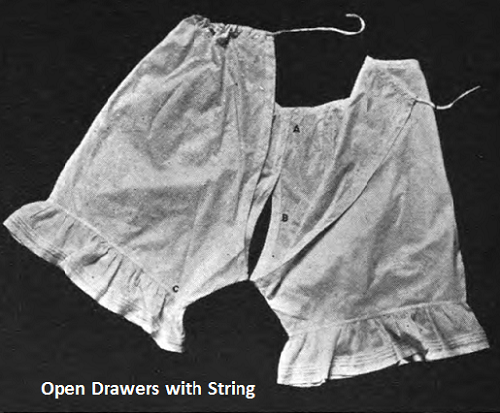
Pantaloons were long undergarments that ran from the waist to the ankle. The drawers were made from light material and finished with frilly edges and a split between the legs. In the early 19th-century, underwear was cumbersome, especially with the almost endless layers of female dresses. Perhaps this was one of the reasons why undergarments came with a split-crotch. It was easier to deal with toilette issues. But by the close of the 1800s, the closed ones gained popularity.
20th Century Undergarments and Intimate Wear
Bloomers were the most popular underwear from the early 1900s and remained popular until the 30s. They were baggy underpants fastened below (or above the knee) and known as knickers or "directoire knickers". Styled after the long pantaloons of the 1800s, they continued to be worn by older women until the mid-1950s. Bloomers were made attractive with bands, ribbon tapes, and lace.
Soon, other items of underwear and finer-structured lingerie emerged. At first, it was the modern hosiery - nylon stockings and then the brassiere (Mary Phelps Jacob designed the first concept of a bra using two silk handkerchiefs and a pink ribbon). By the forties and fifties, women began to wear briefs.
Variations of underwear have evolved almost three-quarters of a century later. However, thong-like intimate wear continues to be highly popular in the 21st-century.
A Brief Summary of Female Underclothing
100 AD - Roman women wore a subligaculum which appears like crude shorts-like wear or came as simple loincloths wrapped around the lower body. Women wore a band of leather or cloth around their chest called a strophium.
13th-Century – Women wore nightie-like garments called shifts (or chemise) under their clothing. That was about it. They did not usually wear underpants.
16th-Century - Some women wore drawers. According to historical facts, Eleanor of Toledo owned a pair of drawers in the mid-1500s. Although women wearing drawers was frowned upon by some, decades after, many were custom-made for Maria de Medici (1573–1642), the new Queen of France, but that is all we know about wearing drawers at this time.
17th-Century - Many wealthy women wore silk stockings and farthingales. A farthingale is an undergarment created to give a woman a silhouette that extremely enlarged her body from the waist down. However, it is said to originate from Spain in the 15th-century. Farthingales were used by the elite, primarily by court women displaying their wealth and status in society.
19th-Century - Women begin to wear white knickers. By the 1860s, some wore coloured knickers and petticoats but white remained popular. The underprivileged had to make their knickers from flour sacks and old clothes, and during the 2nd World War, women sometimes made their knickers from parachute silk.
20th-Century - The early years (the first decade) saw the first pair of knickers. They ran from the high-waist to around the mid-calf but by the 1920s they gradually became shorter, first rising from the calf to the knees, and then up to the mid-thighs. In the 1940s, the more fashionable women began to wear full feminine pants. Not unlike briefs, they came in a variety of styles and colours. Soon a variety of patterns followed. Thirty years after, thong underwear came to be.